
Upgrade to European maternity care in London
Your sister in Lyon had the same midwife from her first appointment to her baby's six-week check. Your best friend in Amsterdam had a maternity nurse at her door every morning for up to ten days after the birth. And you, pregnant in London, have just been told your first appointment is in six weeks' time.
If that gap feels strange, it is because it is. Across much of Europe, a midwife who knows you is simply standard care, and for good reason: it means fewer caesareans, fewer interventions at birth, and problems spotted sooner.
The good news: you do not have to move home to get it. Here is how to hack maternity care in London and bring the best of Europe to your doorstep, alongside your hospital care.
What mothers get across Europe
Norway, ranked the best place in the world to be a mother by Save the Children, gives pregnant women a municipal midwife (jordmor) at their local health centre, and the same midwife often comes to the house after the birth. Even on the labour ward, one British mother of three found a midwife waiting at the door in the middle of the night, and her birth plan followed in full.
In the Netherlands, a community midwife (verloskundige) looks after women with straightforward pregnancies from the moment they find out they are pregnant until the birth. Once the baby arrives, kraamzorg begins: a trained maternity care assistant visits daily for the first eight to ten days, typically for around 49 hours in total. She checks on mother and baby, supports feeding and helps the household find its rhythm.
In Germany, a midwife (Hebamme) is with you throughout: in pregnancy, at birth and for twelve weeks afterwards, visiting daily in the first days at home, all covered by statutory health insurance. One German mother we spoke to estimates she spent around 40 hours with her Hebamme in total.
In France, care starts from the positive pregnancy test. Women choose their own lead midwife (sage-femme référente), who runs most appointments and organises follow-up after the birth. 8 hours of birth preparation are covered, and every new mother is offered state-funded perineal rehabilitation, standard practice for around 40 years.
Start to notice a theme? The details differ from country to country. The principle does not: one known midwife, real time to prepare, and proper support in the weeks after birth.
The evidence behind one known midwife
This way of working has a name: midwife continuity of care. It means the same midwife, or a small team you know, from pregnancy through the postnatal weeks, working alongside obstetricians and specialists whenever they are needed.
It is one of the most studied models in maternity care, and widely considered the most effective. The latest Cochrane review (2024), covering 17 trials and more than 18,500 women, found fewer caesareans and instrumental births, more spontaneous vaginal births and more positive experiences of care. An earlier edition also found fewer preterm births.
The contrast is hard to ignore. France has held its caesarean rate at around 21% for years; in England, it has risen to 45%. Many factors are at play, but the gap speaks for itself.
The World Health Organization recommends the model, with hospital teams providing specialist support alongside it. In London, the NHS continuity pilot POPPIE reported 98% satisfaction, and the CQC's 2025 national maternity survey found that women who saw the same midwife more often felt more listened to, better supported and more involved in decisions.
What is missing from maternity care in London
England has wanted continuity of care for a decade, and the 2026 National Maternity and Neonatal Investigation, led by Baroness Amos, named it again among its recommendations.
"We know midwife continuity of care matters. Why isn't it there?" asked Dr Penny Dash, Chair of NHS England, in the latest maternity review.
Funding and staff shortages have kept it out of reach: today, only 1 in 5 women see the same midwife throughout their pregnancy, and none in postpartum. For women categorised as "low risk", what remains is a pathway that is safe, but light.
It starts late. Care often only begins properly at the end of the first trimester, so the most intense, anxious weeks pass with no checks and nobody to talk to.
Then come short appointments, often with a different midwife each time and little chance to read your notes. Around 1 in 4 mothers experience perinatal mental health difficulties, yet there is rarely space to say so. "How are you?" "Very well, thank you." Why say more, when the appointment is over in five minutes? At one of the most life-changing moments of your life, it is easy to feel like a number.
And it ends early. Community midwife visits usually stop within 5 to 10 days of the birth, just as the emotional weight of new parenthood lands, along with the round-the-clock work of feeding and caring for a newborn. Research shows this is exactly when mothers are most vulnerable: from around day 10 and throughout the first month.
Private hospitals rarely close these gaps either: continuity is not guaranteed, and support usually ends at discharge.
None of this reflects on the people working in maternity care, who are committed and highly skilled. London's hospitals offer outstanding obstetricians, specialist teams and emergency care. What a stretched system struggles to give is time, and the same face.
Bringing the European model to London
"I created The Motherhood Practice after giving birth in France, then in the UK," says co-founder Sarah Seror. "I had good birth experiences in both, but I was shocked by the differences in follow-up before and after. I wanted to close these gaps in smart collaboration with the NHS, to give families what they truly need: one dedicated midwife, throughout their birth journey."
Our care sits alongside your hospital care, NHS or private, never instead of it. Here is what it includes:
- One dedicated midwife, from your positive test to six weeks after birth, well before your hospital booking appointment. She knows your history, so you never start from the beginning.
- Hour-long antenatal consultations at home, with full antenatal checks and time to talk, arranged around both partners' working lives.
- Three preparation workshops for both parents: your birth options, birth preparation, and the fourth trimester, including feeding and recovery.
- A direct WhatsApp line to your midwife, seven days a week.
- Weekly home visits after birth, caring for mother, baby and partner, with feeding support (breast or bottle) and newborn care.
- A postnatal assessment with a specialist women's health physiotherapist, covering pelvic floor and abdominal recovery, systematically included in every package.
- Seamless links with your hospital: clinical notes handed over, anything urgent escalated promptly, and referral to our network of specialists, from scan clinics to physiotherapists and therapists, when needed.
What this looks like in practice
Twelve days after the birth, a mother messages her midwife late in the evening. The baby is feeding almost constantly, she is unsure whether he is getting enough, and she has been tearful all day. The next morning, the midwife who has known her since eight weeks of pregnancy is at the door. She weighs the baby, watches a feed, adjusts the latch and asks how her client is really feeling. She already knows the birth story and what matters to this family. If anything needs a doctor, she knows exactly who to call and what to tell them.
One client, an associate director in a European bank expecting her second baby, put it this way: "Visits at home, with the same midwife, in a relaxed environment… My partner is completely involved and engaged."
Who will look after you
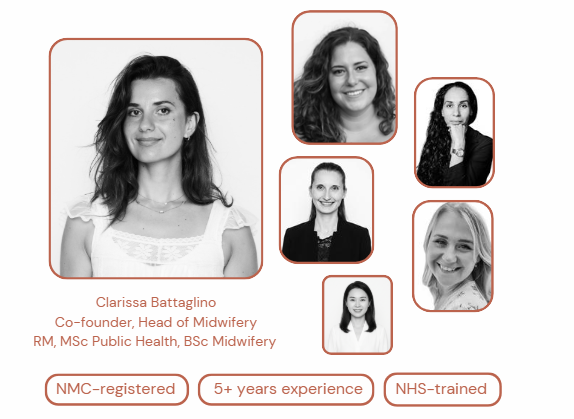
Co-founder Clarissa Battaglino, a senior NHS midwife for more than ten years, knows the gap from the other side.
"So many times, I have wished I had more time for the families I see at the hospital, and I simply could not give it," she says. "Seeing a midwife who knows your story is not a nice-to-have. It is safer care. So much can be prevented with time to listen, to talk things through, and to explain the evidence."
Our team of 10 registered midwives brings more than 80 years of combined experience, with expertise in fetal medicine, lactation, gestational diabetes and pelvic floor health. Every one of them still practises part-time in the NHS, so they understand your hospital's systems from the inside and can help you navigate them with confidence.
The best of both
Having a baby far from home can feel like setting off without a map. You do not have to choose between world-class hospitals and the personal care your friends in Lyon, Amsterdam, Oslo or Munich take for granted. In London with The Motherhood Practice, you can have both.
If you would like to talk it through, book a free 20-minute call with our co-founder and lead midwife, Clarissa.
Frequently asked questions
Does a private midwife replace my NHS care? No. We work alongside your NHS or private hospital team. You keep all your scheduled appointments and scans, and we hand over notes and escalate any concern to your hospital promptly.
How early can I start? From your positive pregnancy test. Many families join us in the first weeks, before their hospital booking appointment.
Do you visit me at home? Yes. All visits take place at home across Greater London, at times that suit your working schedule (and your partner's!).
References
- King's College London: 2024 Cochrane review on midwife continuity of care
- Cochrane 2016 review appendices: preterm birth RR 0.76
- WHO recommendation on midwife-led continuity of care (via BIGG)
- CQC: 2025 national maternity survey press release
- Healthwatch North Northamptonshire: summary of the investigation's recommendations
- NHS England: Midwifery Continuity of Carer letter, 21 September 2022
- NHS Maternity Statistics 2024-25
- Santé publique France: Enquête nationale périnatale 2021
- Munk-Olsen et al., JAMA, 2006: new parents and mental disorders (add link)
- POPPIE trial, 2021 (add link)
- The Local Norway: Save the Children Mothers' Index 2015
- Living a Nordic Life: having a baby in Norway
- Expat.com: pregnancy in Norway
- IQWiG informedhealth.org: After the baby is born (Germany)
- Live in Germany: having a baby in Germany (midwife cover at birth)
- IamExpat: Postnatal care in the Netherlands
- AP-HP: Décret 2023-1035 on the sage-femme référente
Keep reading
More from the blog.

Let’s start with a chat.
A free 20-minute chat with Clarissa. No pressure, no commitment, just space to ask whatever is on your mind.