
Why a private midwife is not a doula, and why that difference matters
You have probably heard of doulas by now. Perhaps a friend used one and spoke warmly of the experience. Perhaps you have seen them in the same conversations as hypnobirthing instructors and birth photographers, in that general category of taking your birth seriously. They are increasingly visible in London's maternity world, and for good reason. The emotional support they provide is real. For many women, it matters.
This article is not an argument against doulas. It is an argument for understanding exactly what you are choosing, and what you are not, when you decide who will be beside you through pregnancy and birth.
Because the difference between a doula and a registered midwife is not a matter of warmth, or experience, or how much they care about you. It is a matter of professional scope, clinical authority, and a particular kind of knowledge that only comes from working inside the system. The difference, in a word, is the pivot.
A doula is present. A midwife is the pivot.
A doula is a trained birth companion. She provides continuous emotional and physical support during labour: breathing techniques, positioning, reassurance, a steady presence in the room. The best doulas are deeply skilled at what they do. Research consistently shows that continuous support during labour improves outcomes and experience. That is not in question here.
What a doula is not, is a clinician. Doulas in the UK are not regulated by any statutory body. There is no mandatory training standard and no legal scope of clinical practice. Individual training programmes vary considerably. A doula cannot interpret clinical findings, make decisions about escalating your care, or arrive at your birth already knowing the hospital's protocols and the consultants who work there.
A registered midwife operates on an entirely different professional footing. Midwives in the UK are regulated by the Nursing and Midwifery Council. They complete a three-year degree. They are trained in obstetric emergencies, neonatal resuscitation, and the recognition of deteriorating conditions in pregnancy and postpartum. They have spent years working in NHS hospitals, which means they speak the language of that system fluently. They know the protocols. They know how to be taken seriously in a room where decisions are being made. When they advocate for you, the team listens.
That is what it means to be the pivot. Not just present. Not just supportive. But positioned between you and the system, with the professional standing to move between both.
What she brings to pregnancy that nobody else can
The pivot role does not begin at birth. It begins at your first appointment, and it is perhaps most valuable in the months before you ever set foot in a labour ward.
When something complex arises in pregnancy, a doula can listen and hold space. A registered midwife can tell you what it means. She can translate the language of your consultant's letter into plain terms. She can tell you which questions to ask at your next hospital appointment, and what the evidence actually says about your options. She can sit with you and work through every realistic birth scenario, including the ones you are hoping not to need, so that when the moment comes you are equipped rather than frightened.
This is not generic reassurance. It is clinical preparation, grounded in evidence and calibrated to your specific situation. And it is offered without judgement. Whatever your choices, your fears, your birth preferences or your complications, the conversation is honest and the options are yours.
One woman who came to us during her pregnancy had spent months working with a wellness practitioner who had no clinical background. When she received a diagnosis that required monitoring, the advice she was given was to place her hands on the affected area and speak to it with positive intention. Her hospital registration, her referral letters, the appointments she needed: she had navigated all of it alone, despite a demanding full-time job and no support in reading what any of it meant. She arrived with us weeks behind on care that should have happened much earlier.
There was no judgement in our response to that. But there was clarity. We knew what her diagnosis meant clinically, what it required, and what to do next. We contacted her consultant on her behalf. We made sure nothing else slipped.
A doula could not have done that. Not because she was not caring, but because that is not what a doula is trained to do.
In the birth room
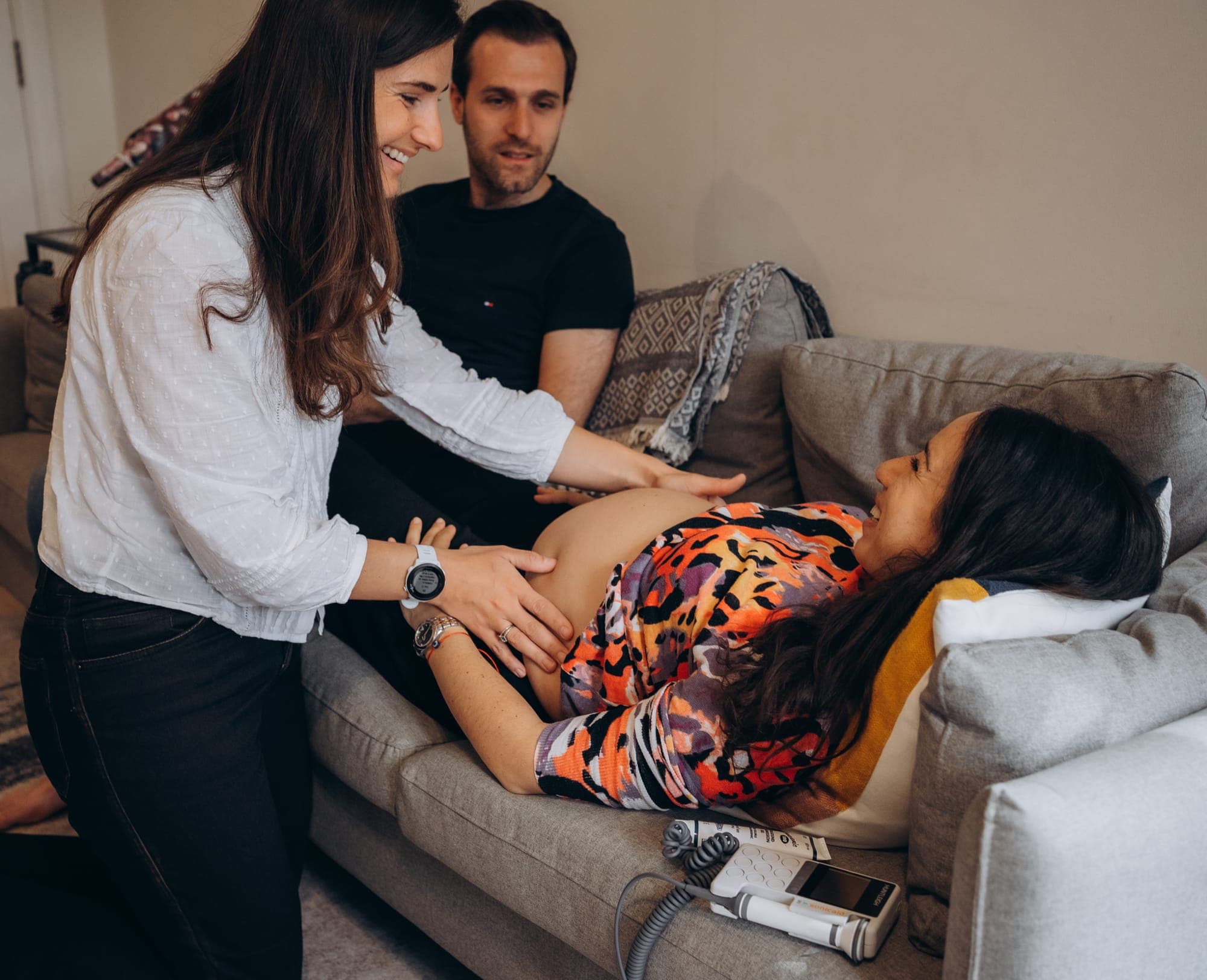
During birth, our midwives attend as your birth partner, not as the lead clinician. That role belongs to the hospital team. But attending as a birth partner with a registered midwife's training is a fundamentally different experience from attending with a doula.
She can read the monitor on the wall and tell you what it means. She knows the difference between a pattern that is normal and one that warrants a conversation with the registrar. She knows the hospital's procedures from the inside, because she has worked in hospitals. She knows how to raise a concern in a way that is heard. She is not a visitor navigating an unfamiliar system. She is a peer, operating within it, entirely focused on you.
And because she has cared for you throughout your pregnancy, she arrives already knowing everything that matters. Your history, your fears, your preferences, your complications, your decisions. She does not introduce herself as your labour begins. She has been beside you for months.
That continuity is not a comfort feature. It is clinically significant. The Cochrane Review's evidence on midwife-led continuity of care is consistent: women who receive care from a known midwife throughout pregnancy, birth, and the postnatal period have better outcomes and are more likely to report a positive experience. They are also less likely to require medical intervention in labour.
The question worth sitting with
If you are weighing a doula against a private midwife, the question is not which option feels nicer. The question is what you need from your care.
If you want emotional support and continuous presence at your birth, both can provide that. If you want someone who can prepare you clinically for every scenario, who can translate the medical system and navigate it on your behalf, who arrives at your birth already knowing your story and carrying the professional authority to act within that system if she needs to: that is a private midwife.
You are not choosing between support and medicine. You are choosing between support alone, and support with the clinical knowledge, professional standing, and full continuity to be your pivot through all of it.
What we provide
At The Motherhood Practice, our midwives are registered, experienced, and present from early pregnancy through birth and into the postnatal weeks. During pregnancy, we visit you at home, walk you through your options at every stage, and prepare you for your birth with evidence-based information across every realistic scenario. At your birth, we are beside you as your birth partner, with the clinical knowledge to understand what is happening and the professional standing to advocate for you when it matters. Afterwards, we visit weekly for six weeks, because the postnatal period does not end at day ten.
We work alongside the NHS, not instead of it. We are the layer of care that connects you to it properly, and keeps you informed, supported, and protected throughout.
If you would like to understand what that looks like for your specific pregnancy, we would welcome a conversation. No obligation. Just space to ask your questions to someone who has the time, and the training, to answer them properly.
Book a free 20-minute call.
Keep reading
More from the blog.

Let’s start with a chat.
A free 20-minute chat with Clarissa. No pressure, no commitment, just space to ask whatever is on your mind.